

Buy Verified Stake Account: Details That Matter
What does “verified” prove when a Stake account is listed for sale? If you’re searching to buy verified stake account access, an identity check may sound reassuring. But it doesn’t establish that the account can be transferred, that you’ll retain access, or that the original owner’s identity won’t remain connected to it.
It’s reasonable to want clear answers before risking money, access, or personal information. Stake’s terms prohibit buying, selling, or transferring customer accounts, and a verification claim doesn’t override that restriction. This article explains what verification can indicate, what it can’t promise, and why an account may still face identity checks or access problems after a handover. It also covers which listing details deserve scrutiny, what missing information leaves unanswered, and how to assess platform-policy and privacy risks. Gameoro facilitates peer-to-peer account listings, but marketplace access isn’t platform authorization or a guarantee of continued access.
Key Takeaways
- Identify exactly what a seller means by “verified” instead of relying on the label alone.
- Review account status, supporting evidence, access terms, and transaction conditions. Treat vague or missing details as unanswered questions.
- Before you buy verified stake account access, weigh the listing against Stake’s current rules and consider the risks to account access and personal information.
- Follow a clear review sequence: read the claim, examine the details, check platform rules, assess the transaction terms, then decide.
- Understand the difference between a marketplace facilitating a peer-to-peer listing and Stake authorizing an account transfer.
What Does “Verified Stake Account” Mean in a Listing?
In a listing, “verified” generally refers to an identity-check status associated with an account. It doesn’t establish that ownership can be transferred, that the seller has permission to transfer it, or that a new user will retain access. Treat the label as a claim to interpret, not proof that every part of a transaction is valid or secure.
Identity checks, login credentials, and transfer permission are separate issues. A platform may ask a user to submit personal information as part of a Know Your Customer process. The Know Your Customer (KYC) regulations concept helps explain why identity checks exist, but a seller’s use of “verified” doesn’t tell you which checks were completed or whose information is attached to the account.
Verification status is not the same as account control
An identity check concerns information submitted to a platform. Login access concerns whether someone can enter the account now. Neither establishes who may regain control later. For example, having a username and password doesn’t show who controls the linked email, phone number, or other recovery methods. It also doesn’t establish that the platform will recognize a change in user or preserve access afterward.
Keep these questions distinct:
- Verification: What identity-check status does the seller claim, and whose information was used?
- Control: Which credentials or contact methods are accessible, and who else may retain control?
- Permission: Do the current platform terms allow an account to be transferred?
A claim in one category doesn’t settle the others. Verification alone cannot establish future access. If your goal is to buy verified stake account access, determine what the label actually describes before treating it as a sign of lasting control.
Why the word “verified” needs context
Read the exact wording in the listing. Does it say an identity check was completed, that a particular verification step is finished, or simply that the account is “verified”? These statements provide different levels of detail. Note the claim as written, and distinguish the seller’s description from a status displayed by the platform itself.
A screenshot or other seller-provided evidence may illustrate a claim, but it can’t establish every relevant fact. It may not show whose identity was checked, whether the status is current, or whether the account can be transferred under the platform’s rules. Don’t fill those gaps with assumptions. A precise listing should explain what “verified” refers to and what evidence supports that specific claim.
Verification is a status claim, not proof of transfer permission. Keep that distinction in view as you read any listing. Consult the platform’s current published terms and help information to understand a platform-specific verification label. Definitions and requirements can change, and a marketplace description cannot replace them.
Which Stake Account Details Should You Read Beyond the Verification Label?
A useful listing gives you more to assess than a badge or one-word status. Review it in four parts: account status, supporting evidence, access terms, and transaction conditions. Compare each claim with the details shown in the listing. If information is missing or vague, treat it as unanswered, not as proof that the claim is false or true.
Read status claims precisely
Separate identity-check descriptions from claims about account history or current standing. “Verified” may describe an identity check, while “in good standing” suggests something different. Look for the specific status claimed, when it was checked, and any limits or conditions stated. A listing badge or seller’s wording alone doesn’t establish platform approval or confirm that a status still applies.
For example, “verification completed” doesn’t tell you whether the account has restrictions or whether the status depends on later checks. Compare the listing’s wording with any evidence shown beside it, and note what the evidence doesn’t establish. For platform rules, consult the current Stake.com Terms of Service. A marketplace description isn’t a substitute for the platform’s published terms.
Check evidence, access, and transaction terms
Evidence needs context. Consider whether it supports the precise claim, appears current, and avoids exposing sensitive personal information. A cropped image or status badge may show only part of the picture. Don’t share identity documents or private credentials to fill in details that a listing leaves unclear.
Next, read the access and transaction terms. Look for a plain explanation of what information is involved, what the buyer is expected to receive, and what access remains with the seller. Review any stated inspection period, communication expectations, and dispute terms before committing. Don’t assume that login information, control of recovery methods, and continued access are all included just because a listing says “full access.”
- Account status: What is claimed about verification, restrictions, or account history?
- Evidence: What information supports each claim, and what remains unshown?
- Access terms: Which credentials or account details are described as part of the transaction?
- Transaction conditions: What inspection, communication, and dispute terms are stated?
Use a gaming account listing comparison checklist to compare descriptions consistently. The same method applies if you’re considering whether to buy verified stake account access: match each claim to its evidence, then note anything unresolved before deciding.
Every material listing claim should be specific enough to evaluate. If the status, access, or transaction conditions remain unclear, pause instead of assuming the missing detail works in your favor. You can also browse betting account listings on Gameoro and apply these checks to the details presented.
Does a Verified Stake Account Mean It Is Safe or Transferable?
No. A verified label doesn’t automatically mean an account is safe to acquire, transferable under Stake’s rules, or protected from later access changes. It describes a claimed status, not a promise about what will happen after a transaction. Assess verification, platform permission, account access, and transaction terms separately.
A marketplace can facilitate a peer-to-peer listing and set transaction conditions. It can’t grant permission on Stake’s behalf or guarantee that the platform will recognize a change in account user. Even clearly stated transaction terms don’t replace Stake’s own policies. Read the current official terms for the specific Stake service before making a decision, since policies and requirements can change.
What verification cannot establish
Verification alone can’t show that a future transfer is permitted. It also can’t guarantee that credentials will remain valid, that the seller won’t retain a way to access the account, or that the platform won’t request further checks. A listing and transaction agreement describe what the parties claim or expect. They don’t control the platform’s later decisions.
Before considering whether to buy verified stake account access, ask what each source actually establishes. The listing presents specific claims, the transaction terms describe what participants agree to, and Stake’s current published policies set platform requirements. If those sources don’t align, don’t assume the most reassuring interpretation is correct. Pause until you understand the unresolved risk.
Identity checks and personal information
Account verification may involve sensitive personal information, such as identity details or supporting documents. That information can create privacy risks if it’s shared, stored, or handled by someone who shouldn’t have access. Consider whose information is connected to the account and what personal data you’d be asked to provide or receive. Don’t send identity documents or credentials casually to resolve a vague listing claim.
Never use another person’s identity or try to evade a required identity check. A seller’s claim that an account has already passed verification doesn’t remove your responsibility to follow applicable platform requirements. Stake’s Anti-Money Laundering Policy provides context for why identity and transaction checks matter. Read the relevant current policies directly, rather than relying on a seller’s summary to interpret them.
- Platform policy: Check the current terms for the relevant Stake service.
- Transaction terms: Understand what the parties have agreed to, without treating it as platform approval.
- Privacy: Limit exposure of identity documents, credentials, and personal account details.
If transfer permission, future access, or identity responsibilities remain unclear, stop and reassess. A verified status is not a safety guarantee, and no marketplace description removes the need to understand the platform’s rules and the transaction’s limits.
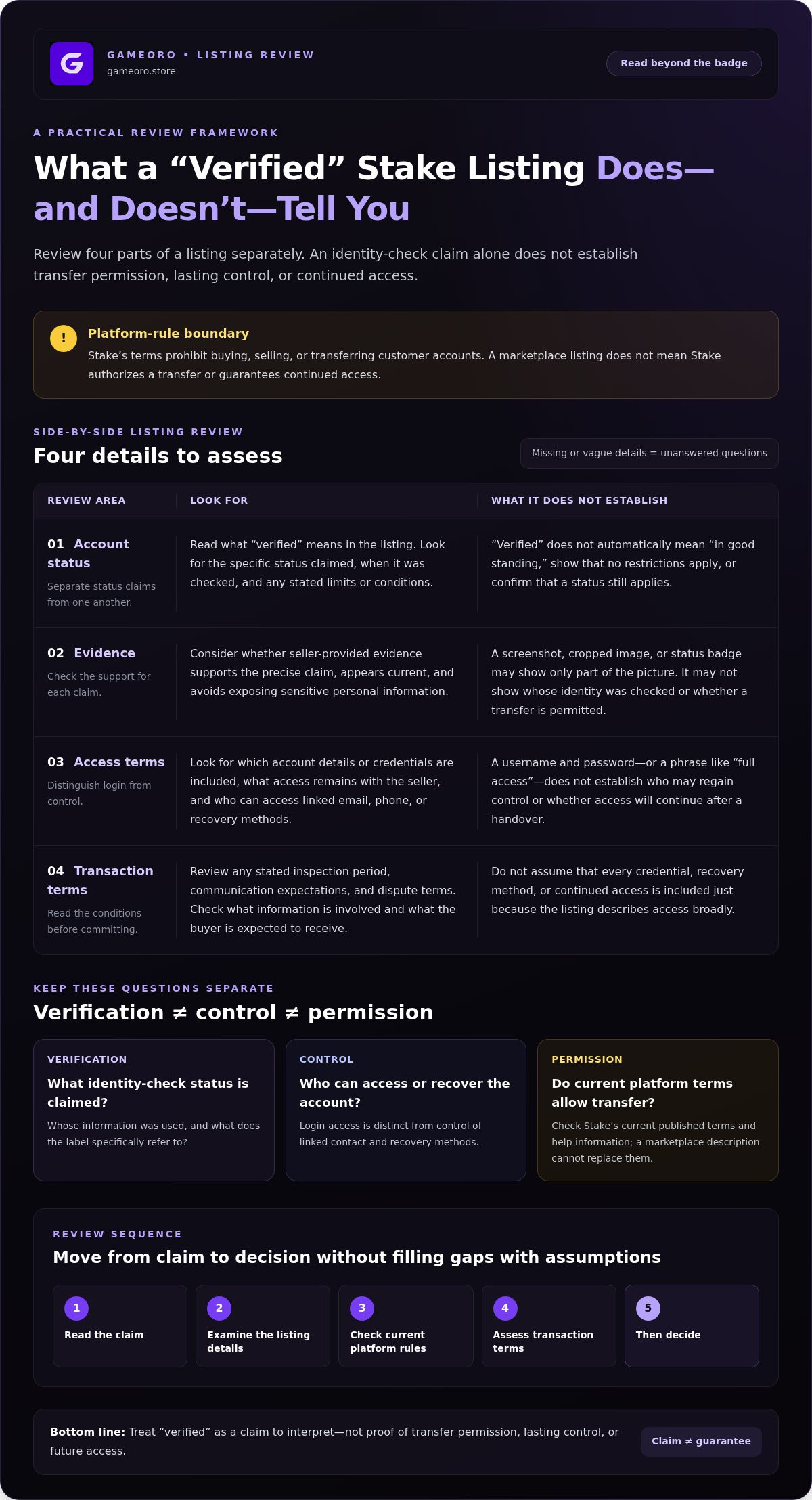
How to Assess a Stake Account Listing Before You Decide
Use a fixed review sequence. It helps keep a persuasive label from rushing your decision and separates what the seller claims from what platform rules allow. If an important status or access detail remains unclear, pause. No checklist can guarantee future access or override Stake’s current policies.
- Read the claim. Note the exact wording about verification, account status, and included access.
- Review the supporting details. Compare each claim with the information or evidence shown in the listing. Record what it doesn’t answer.
- Check current Stake rules. Read the official terms and verification requirements for the relevant service. Don’t rely on an old summary or seller interpretation.
- Assess transaction terms. Understand the stated communication process, inspection conditions, and any dispute terms before committing.
- Decide only after review. If a material claim remains ambiguous or conflicts with platform rules, don’t treat the listing as an exception.
This sequence supports a deliberate assessment, not a prediction. Even detailed listing information can’t promise that an account will remain accessible or that the platform will approve a transfer. For a broader framework you can apply to account listings, use this step-by-step guide to buying a gaming account safely.
Resolve listing ambiguities before proceeding
Identify exactly what remains unanswered: verification status, current account standing, included access details, or what happens if the handover doesn’t match the listing. Use the marketplace’s stated communication process and keep transaction messages on record. Don’t send passwords, identity documents, or payment details through informal channels or outside appropriate secure processes.
Be specific when reviewing a claim. “Verified” may refer to an identity check, a particular status, or a seller’s general description. Determine which meaning the listing supports. If the available information still doesn’t resolve a material issue, record it as unresolved. Don’t interpret silence or vague wording as reassurance.
Use current rules as a decision checkpoint
Before any transaction, check Stake’s current published terms and verification requirements. Focus on whether the proposed transfer is allowed and what obligations or checks may apply. Rules can change, so use official information current at the time of your decision. If a proposed transfer conflicts with the platform’s rules, don’t treat a seller’s claim or a marketplace listing as an exception.
Keep the sources distinct: platform rules describe Stake’s requirements, listing details describe the seller’s claims, and transaction terms describe what the parties agree to. None substitutes for another. If you’re comparing how account listings are presented from a seller’s perspective, the verified Stake account seller guide offers that marketplace context.
If you’re ready to compare listings, browse betting account listings on Gameoro with this review sequence in mind. Read first, then decide only when the material terms are clear and consistent with the platform rules.
Where Marketplace Listings Fit in a Careful Buying Decision
A marketplace listing brings a seller’s description together with a buyer’s assessment. Gameoro facilitates peer-to-peer transactions for betting accounts, but it doesn’t directly own every account shown. A listing isn’t proof that Stake has approved a transfer. Marketplace facilitation also doesn’t guarantee an account’s legitimacy under Stake’s rules, continued access, or recovery if access is lost.
Understand the marketplace’s role
Keep the roles separate. The seller provides claims about an account. The marketplace provides a place to browse peer-to-peer listings. Stake sets its own account policies and verification requirements. These are distinct parts of a transaction, and one doesn’t replace another.
This distinction matters especially for Stake accounts. Stake’s terms prohibit selling, transferring, or acquiring customer accounts, and attempts may result in associated accounts being cancelled. Check the relevant official Stake terms directly before acting. A listing, seller assurance, or marketplace presence doesn’t create an exception to platform rules.
A marketplace listing also isn’t account recovery, publisher backing, or a promise that an account will remain accessible after a transfer. Transaction terms describe what the parties state or agree between themselves. They can’t change Stake’s policies or determine how the platform will respond to an account or identity check.
Choose a next step with clear expectations
Before deciding, understand the listing’s exact claims, the stated transaction conditions, and the current platform rules. Treat these as separate sources. If the listing suggests a transfer that conflicts with Stake’s terms, don’t proceed on the assumption that “verified” or marketplace-listed means permitted. If the account’s status or access is unclear, pause rather than relying on an inference.
For anyone searching to buy verified stake account access, the key decision isn’t just whether the label sounds convincing. Consider whether the proposed action fits the platform’s current rules and whether you accept the remaining uncertainty about access and personal information. No marketplace can promise that a platform will authorize a transfer or preserve access.
Gameoro facilitates peer-to-peer account listings, not Stake transfers authorized by the platform or outcomes guaranteed under Stake’s policies. Browse the betting account marketplace to review listings, keeping those boundaries in view.
Make Your Next Move Deliberately
Before acting on a listing, decide what level of uncertainty you’re willing to accept. Set that boundary before urgency, a persuasive seller, or a prominent “verified” label starts shaping your decision. If the platform’s rules don’t permit the proposed transfer, or key facts still can’t be established, walking away is a valid outcome.
If you’re researching how to buy verified stake account access, ground your next step in current official policies. A marketplace can help you review peer-to-peer account listings, but it can’t replace platform authorization or settle questions about future access. Browse with clear expectations, and don’t proceed on assumptions you wouldn’t accept in any other transaction.
Browse Gameoro’s account marketplace to review listings with care. Take your time, protect your information, and choose the path that fits the facts you can verify.
Frequently Asked Questions
Does a verified Stake account mean the account is safe to buy?
No. Verification doesn’t remove the policy and access risks tied to an account transfer. Stake’s published terms prohibit buying, selling, or transferring customer accounts, and attempts may lead to associated accounts being cancelled. If you’re searching to buy verified stake account access, don’t treat a completed identity check as protection against those outcomes. Review the current terms for the specific Stake service before deciding whether to proceed.
Can a Stake account’s verification be transferred to another person?
Don’t assume it can. An identity check relates to information submitted for a particular user. It isn’t a portable credential that a buyer can simply inherit. A change in who uses an account may raise separate questions under the platform’s current terms and verification process. Check official Stake guidance for the relevant service, and don’t change identity information in a way that misrepresents who you are.
What should a Stake account listing say about verification?
A clear listing should describe the specific status being claimed, any stated date or condition, and what supporting information demonstrates. It should distinguish an identity check from claims about account history, restrictions, or access. For example, “identity check completed” is more specific than “fully verified,” but still doesn’t explain every account condition. Avoid requesting or sharing unredacted identity documents to validate a seller’s wording.
Can I use my own identity details on a purchased Stake account?
Don’t assume you can replace the identity details associated with an account. Stake’s terms prohibit account transfers, so submitting your information doesn’t make a purchase authorized or guarantee that the account can be used. Use truthful information only through a process Stake permits for your own account. Never submit another person’s documents, alter identity details to avoid a check, or follow instructions to misrepresent who controls the account.
What happens if the seller’s verification claim is unclear?
Pause the decision. The listing should make clear which verification status it describes and what limitations apply. Don’t send payment or personal documents to resolve uncertainty. If the available information remains unclear, treat the claim as unestablished and consider walking away rather than interpreting ambiguity in the seller’s favor.
Does a marketplace guarantee that a Stake account will remain accessible?
No. A marketplace listing can’t control whether Stake later requests checks, changes account access, or applies its own policies. Gameoro facilitates peer-to-peer account transactions. It doesn’t directly own every listed account or guarantee Stake approval or continued access. A seller’s promise to provide login details, for example, can’t ensure the platform will preserve access after a change in account use.
How can I check Stake’s current account rules before buying?
Use Stake’s official terms and help information for the specific service, such as Stake.com or Stake.us. Search those pages for account transfer, account use, identity verification, and access requirements. Read the full relevant passages, not just a search snippet or seller-provided screenshot. Review the published information again close to your decision, since a saved copy or old summary may not reflect current requirements.