
How to Buy a Gaming Account Safely in 2026: A Step-by-Step Guide
What if the account you paid for can still be reclaimed by its original owner? A polished listing and confident seller claims aren’t proof of lasting access. Learning how to buy a gaming account safely means checking the evidence, the handover arrangements, and the risks before you pay.
It’s reasonable to be cautious. Screenshots may not establish full ownership, and a seller who can’t transfer control of the linked email or recovery details may leave you exposed. There’s another risk: a game publisher may prohibit account transfers and restrict an account that changes hands. A marketplace transaction can’t guarantee publisher approval or permanent access.
This guide lays out a practical sequence to reduce avoidable risks. You’ll learn how to assess listing claims, review transaction details, understand payment and inspection terms, and secure access during handover. You’ll also see what to document before confirming a transaction. Gameoro connects gaming account buyers and sellers through a marketplace. Use the listing and transaction information to inform your own checks, not as a substitute for them.
Key Takeaways
- Use a five-step listing review: define what you need, inspect the details, compare evidence, read the terms, and decide.
- Match the listed game, region, platform, progression, and included items against your requirements before proceeding.
- Before checkout, review the written payment, inspection, cancellation, and dispute terms so you understand the transaction process.
- Follow a careful handover order: receive access, inspect the agreed details, secure the credentials, and document completion.
- Learn how to buy a gaming account safely by applying the same checks to every listing, including options on Gameoro’s buyer-and-seller marketplace.
Before buying a gaming account, understand the risks and rules
A third-party gaming account purchase is a transaction between separate users: one offers an account, and another pays for it. The account may include games, progression, or items with value within a game’s virtual economy. But completing a transaction doesn’t automatically transfer recognized ownership, guarantee lasting access, or earn approval from the game publisher.
A completed payment confirms a transaction, not guaranteed long-term access to the account. Keep that distinction in mind throughout the buying process. A marketplace can facilitate a buyer-seller transaction, but it can’t guarantee that a publisher permits the transfer or that access will remain uninterrupted. If you’re learning how to buy a gaming account safely, start by reviewing the rules and identifying what remains outside your control.
Can buying a gaming account violate game rules?
Rules vary by game, publisher, and platform. Some terms restrict or prohibit account transfers; others may set different conditions. Don’t assume a transfer is allowed just because a listing is available or a seller says it’s safe. Read the current terms that apply to the specific game and account before paying. If a transfer breaches those rules, the publisher or platform could restrict the account or take other action under its policies.
What risks remain after a purchase?
The seller may try to recover the account later, especially if they retain access to the original email or recovery methods. Listing details can also be inaccurate: an item, rank, or account feature may not match what was advertised. If either party disputes what was delivered, resolving the issue may be difficult.
Screenshots and seller statements can help you compare claims with the available evidence, but they don’t prove lasting control. A screenshot shows a detail at a particular moment. It can’t establish who controls recovery access or whether the publisher will accept the transfer.
Separate the risks you can reduce from those you can’t eliminate. You can compare claims with available evidence, read the transaction terms, and avoid proceeding when key details are unclear. You can’t guarantee that the original owner won’t attempt recovery or that a publisher won’t act under its rules. Treat any assurance of permanent access or publisher approval as a claim, not a certainty.
Follow these steps to assess a gaming account listing
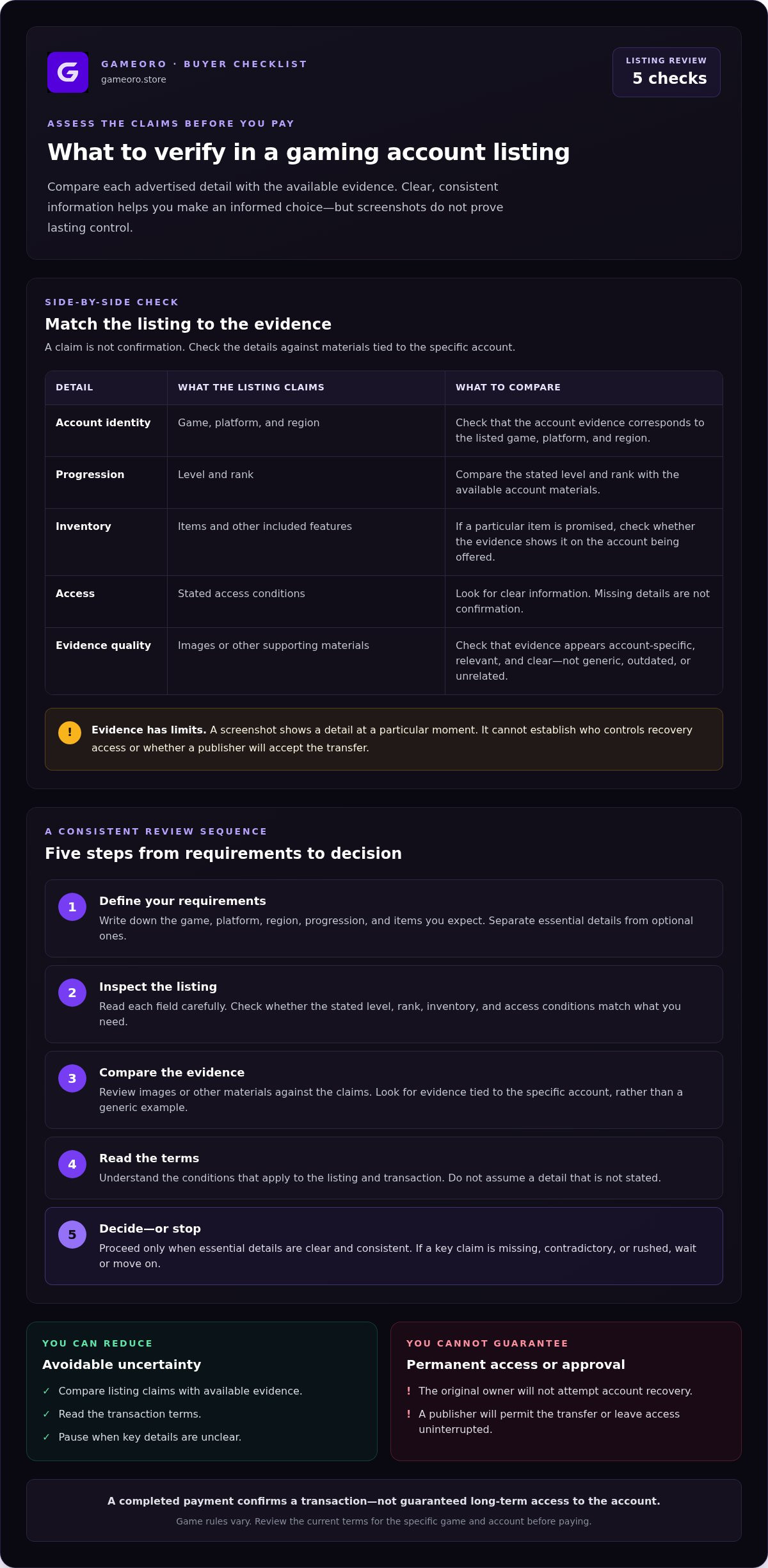
Use the same review sequence for every option. Decide what you need first, then check whether the listing gives you enough information and evidence to make an informed choice. If details conflict or the seller pressures you to act quickly, pause. For anyone asking how to buy a gaming account safely, a consistent checklist is more useful than a persuasive description.
- Define your requirements. Write down the game, platform, region, progression, and items you expect. Decide which details are essential and which are optional.
- Inspect the listing. Read each field carefully. Check whether the stated level, rank, inventory, and access conditions match what you’re looking for.
- Compare the evidence. Review images or other materials against the listing claims. Look for evidence that appears tied to the specific account, rather than a generic example.
- Read the terms. Understand the conditions that apply to the listing and transaction before proceeding. Don’t assume a detail that isn’t stated.
- Decide, or stop. Proceed only if the essential details are clear and consistent. If a key claim is missing, contradictory, or rushed, wait or move on.
Which listing details should match the account evidence?
Compare the game, platform, region, account level, rank, inventory, and stated access conditions. Check each claim against the evidence provided. For example, if the listing promises a particular item, the available image should show that item on the account being offered. Images can support a claim, but they don’t prove permanent control. If evidence looks outdated, unrelated, or unclear, don’t treat the claim as established.
Compare the game, platform, region, level, rank, inventory, and access conditions against the listing evidence. Missing information is not confirmation. Don’t fill gaps with assumptions.
How can you assess seller credibility without relying on promises?
Where seller history or feedback is available, review it alongside the listing. Consider whether the seller’s answers are clear, consistent, and recorded as part of the transaction. Keep important communication within the transaction process so you can refer to it later. If the seller pushes you off-platform, requests direct payment outside the stated process, or makes promises they won’t document, pause. Pressure isn’t evidence.
Use these checks while browsing gaming account listings on Gameoro. Apply the same standards to every listing, then proceed only when the details and terms make sense.
Check access, recovery, and payment terms before you commit
Login details are only one part of account access. Before checkout, understand which registered email is attached, what recovery methods remain active, whether other accounts are linked, and what authentication steps are required. If the seller can’t transfer or clarify control of a relevant recovery channel, you may not have lasting control of the account.
Changing a password or email after delivery may improve security, but it doesn’t erase every recovery risk. The original owner may still have information they can use to make a recovery claim, and publisher rules may still affect the account. Don’t bypass authentication or attempt to access an account without authorization. If a required security step can’t be completed through the authorized handover, stop and resolve the issue before proceeding.
What account access should a buyer understand before purchase?
Clarify the registered email, available recovery options, linked accounts, and authentication requirements as part of the transaction. Understand which details the seller will transfer and which steps you’re expected to complete. If an external account remains linked or a recovery method stays under someone else’s control, treat that as an unresolved access issue, not a minor detail.
How should you compare payment and protection terms?
Read the applicable written terms before checkout. Check how payment is handled, whether an inspection window applies, what evidence may be required, and how to raise a dispute. Pay close attention to what starts or ends an inspection period and whether any action could affect your ability to report a problem.
A payment safeguard applies only as written in the transaction terms. Don’t assume escrow, refunds, or buyer protection are available unless the applicable terms explain them. A documented payment process may give you a record and a route for raising an issue. A direct transfer outside the stated process may leave fewer practical options if the seller doesn’t deliver or a disagreement arises.
- Read the payment and inspection terms before paying.
- Keep the transaction and account-access discussion within the stated transaction process.
- Save relevant messages, delivery details, and evidence with your transaction records.
- If a term is unclear, pause rather than relying on a verbal assurance.
Knowing how to buy a gaming account safely means understanding both what you’ll receive and the process that applies if something goes wrong. Follow the documented payment flow, keep records, and don’t proceed until the access arrangements and terms are clear.
Complete the handover carefully and secure the account
Keep the handover in a clear sequence: receive access, inspect the agreed details, secure the credentials you’re authorized to manage, then document completion. Follow the transaction’s stated inspection process. Don’t confirm receipt just because the seller asks you to hurry.
- Receive access. Use the agreed delivery method and keep relevant details with your transaction records.
- Inspect the account. Compare what you can access with the listing and the terms you agreed to.
- Secure your access. Set a unique password and use available security settings after authorized access has been transferred.
- Document the handover. Record completion, or report a discrepancy promptly through the stated process.
What should you inspect immediately after delivery?
Check that the delivered account matches the agreed game, platform, region, progression, and included items. Confirm you can sign in through the stated login method and access the recovery channels included in the handover. Don’t alter unrelated linked accounts or make changes you’re not authorized to make. If something differs from the agreement, capture relevant evidence and report it through the documented transaction process within the written deadline.
Keep communication, delivery evidence, and any issue reports together in your records. This creates a clear timeline if questions arise. Follow the stated inspection steps before confirming completion. If the seller pressures you to confirm early, rely on the written process, not the pressure.
How can you reduce account-security exposure?
After authorized access is transferred, replace any shared password with a unique one. Enable supported multi-factor authentication where appropriate. Use the game or platform’s official controls to review active sessions and linked services. Make changes only to account settings you’re authorized to manage. Never share passwords, authentication codes, or recovery codes with another user.
These steps reduce avoidable exposure, but they can’t guarantee permanent access or prevent every future recovery dispute. Keep your records, complete the inspection carefully, and confirm the handover only when the account matches the agreed details and the transaction terms allow it. That’s a practical part of learning how to buy a gaming account safely.
Ready to apply the same checks to your next option? Browse gaming account listings on Gameoro and review each listing before proceeding.
Use Gameoro to browse gaming accounts with a clear process
Gameoro is a peer-to-peer marketplace connecting gaming account buyers and sellers. Its listings give you options to assess, but the decision still depends on your checks. Set your requirements first. Then use the same review process for every account instead of relying on promotional wording or seller assurances.
How to use a marketplace without skipping your checks
Before you browse, define the game, platform, region, progression, and account features you want. For each listing, compare those requirements with the available evidence and stated terms. Review account-access details, transaction steps, and applicable game or platform rules as separate checks. A listing that looks suitable still needs to meet each one.
If the evidence doesn’t support a claim, the payment process is unclear, or the account-transfer rules remain uncertain, pause. Don’t treat a marketplace listing as proof that every detail has been independently established. This structured approach is central to how to buy a gaming account safely: assess the specific listing, understand the transaction, and proceed only when the material details are clear.
What a marketplace can and cannot establish
A marketplace facilitates a transaction between users. Listing and transaction information can help you review what the seller has stated and what the parties agreed to. Any safeguards or procedures apply only as described in the relevant written terms. Read those terms before checkout, and keep relevant communication and evidence with your transaction records.
A completed transaction does not, by itself, establish that a game publisher approves the transfer or guarantee permanent access or ownership. Those outcomes are separate from the buyer-seller exchange. Keep that distinction in view as you compare options.
Define your criteria before browsing, then apply them consistently to each listing. Browse gaming account listings on Gameoro when you’re ready to review available options. Compare the evidence, access details, applicable rules, and written payment terms before deciding.
Take the next step with your checklist in hand: Review gaming account listings on Gameoro.
Make your next account purchase a deliberate one
Buying an account involves more than checking its rank or inventory. Review the listing against clear requirements, compare claims with available evidence, and read the access, payment, and inspection terms before committing. Then follow the agreed handover process, secure the credentials you’re authorized to manage, and document any issue promptly.
These steps can reduce avoidable risks, but they can’t guarantee publisher approval or permanent access. Keep that distinction in mind as you decide how to buy a gaming account safely.
Gameoro is a peer-to-peer marketplace where users can browse gaming account listings and transact with sellers. Start with your requirements, then assess each listing and its terms carefully. Browse gaming account listings on Gameoro and take your next step with a clear process.
Frequently Asked Questions
Is it safe to buy a gaming account?
There’s no guarantee that a gaming account purchase will remain safe or provide lasting access. Risk depends on the listing evidence, transaction terms, access and recovery details, and rules for the specific game and platform. Compare claims with the evidence, use the documented payment process, and keep transaction records. If key terms or account details are unclear, pause before paying.
Can a seller recover a gaming account after selling it?
Yes, a seller may be able to attempt recovery if they retain access to recovery channels or can establish prior ownership with the publisher. Changing the password alone doesn’t close every possible recovery route. Before buying, understand which email and recovery methods are involved. After an authorized handover, secure the account using supported settings, but recognize that this can’t eliminate every future access dispute.
What should I check before buying a gaming account?
Compare the listing’s game, platform, region, level, rank, and included items with the available evidence. Review seller history and feedback where provided, and note any missing or conflicting details. Before checkout, read the written payment, inspection, and dispute terms. Also review the current rules for the specific game and platform, since account transfers may be restricted. Don’t rely on seller assurances alone.
Can buying a gaming account get it banned?
It may lead to account restrictions or other action if the game or platform’s rules prohibit transfers or the account is found to violate its policies. Rules differ, so review the current terms for the specific game and platform before deciding. A seller’s assurance and a completed payment don’t establish publisher approval or guarantee that the account will remain active.
How can I pay for a gaming account safely?
Use the documented transaction process and read its written payment and dispute terms before checkout. Check how delivery is recorded, whether an inspection period applies, what evidence is required, and when deadlines begin. Avoid direct payments or off-platform arrangements that bypass the stated process. Don’t assume escrow, refunds, or buyer protection apply unless the terms explain what they cover.
What should I do after receiving a gaming account?
Compare the delivered account with the listing and report any discrepancy promptly through the documented transaction process. After authorized access is transferred, set a unique password and enable supported multi-factor authentication where appropriate. Review sessions and linked services using official account controls. Keep delivery evidence and relevant messages with your transaction records. Never share your password, authentication codes, or recovery codes with the seller.
Does a marketplace guarantee that a gaming account is legitimate?
No. Marketplace participation doesn’t guarantee publisher approval, permanent access, or the account’s history. Gameoro facilitates peer-to-peer transactions and provides a place to browse gaming account listings, but buyers should assess each listing and its terms. Review the evidence, check the relevant game and platform rules, and understand the exact scope of any written protection. Don’t rely on claims that aren’t documented.